

November 2025 Print Edition
The Brief with Laura Beth

Laura Beth Waller, NOSSCR Interim Chief Executive Officer & Deputy General Counsel
Who Will Write the Briefs in 2030? The Mentorship Mandate
People often ask me about the future of Social Security disability law. They worry about the backlog, increased operating costs, and the potential for significant policy changes. But when I look at the future of this practice area, I don’t just see policy problems. I see a pipeline problem. And the solution isn’t just a new regulation. It’s in our willingness to teach.
Right now, NOSSCR’s Mentorship Program is open for applications. This isn’t just a “nice to have” program. It is the critical infrastructure of our future.
I wouldn’t be writing this column today if it weren’t for Chris Dellert. When I was a younger attorney cutting my teeth on federal court briefs, Chris didn’t just employ me; he taught me. Chris walked me through identifying appealable issues and stair-stepped the writing process. My first drafts came back bleeding in red ink. They were giving CSI: SSDI.
Chris always took the time to kindly explain exactly why my argument was flawed, unpersuasive, or clunky. He didn’t fix it for me. He didn’t just rewrite it to save time. He invested the hours to show me how to think about the issues, identify them, persuade the court, and win. That red ink could be painful at times, but it was the most valuable currency I’ve ever received. It was an investment in my competence.
That experience defined my view of NOSSCR’s NextGen community. We are building the future of this practice area, including federal court. But that construction requires two specific investments from our established leaders.
First, we need the investment of time. We need senior attorneys who are willing to do what Chris did. We need you to pick up the red pen—not to criticize, but to cultivate. NOSSCR invests in facilitating mentor/mentee connections because we know that advocacy, and particularly federal court advocacy, is not a skill you learn in a CLE alone. You learn it when someone you respect tells you, “This argument ain’t it, and here’s why.”
Second, if time is the mortar, money is the bricks. I want to acknowledge the firms that are putting their money where their mouth is by sponsoring NextGen events. When a firm sponsors a NextGen retreat or funds a scholarship, they aren’t just buying a logo on a T-shirt. They are ensuring that a young solo practitioner can afford to attend a conference. And, importantly, they are ensuring that newer attorneys remain in this practice area rather than leaving for insurance defense (no shade!).
So, what’s the future of federal court practice? We are entering a post-Chevron era where the courts are more powerful than ever. We, collectively, cannot afford to send untrained lawyers into those battles. If we want to win on the big issues, we need a bench of lawyers who have been mentored and prepared by the best.
NOSSCR has built the structure. Now, I am asking you to fill it.
- If you have knowledge: Apply to be a mentor. Honor the person who taught you by teaching someone else.
- If you have resources: Sponsor a NextGen event. Invest in the longevity of your practice area.
- If you are hungry to learn: Apply to be a mentee. Be willing to see the red ink.
Applications for our Mentorship Program are now open. The future of our practice isn’t waiting for a policy change. It’s waiting for you to sign up.

Dispatches from Camp
David Camp, NOSSCR Senior Policy Advisor & General Counsel
The Social Security disability advocacy community is small but passionate—filled with diverse perspectives and strong voices. But our power lies in unity. While we may disagree on messaging, priorities, and strategies, when we unite for a common goal, real progress is possible. Collaboration yields positive change for our profession and the claimants we serve.
As you hopefully saw in our emailed message this morning, on behalf of NOSSCR and our growing coalition, I spoke with Commissioner Bisignano yesterday and he asked me to tell you that he never intended to launch any disruptive regulatory package, as it is not on his list of priorities as Commissioner. What this means is that, for now, SSA does not plan to move forward with regulations addressing the grids, vocational rules, age criteria, or other sweeping updates to RFC determinations and steps 4 and 5 as we’ve been discussing.
While we await formal changes to the unified agenda, please understand that this is not a “win” or a “loss.” The work of SSA’s policy component in maintaining current disability regulatory policy—especially given the outdated DOT and years of payments from SSA to DOL for updated vocational surveys—won’t end. SSR 24-3p is a good example—the component parts of any regulatory package will continue to be released in all the various ways SSA guides adjudicators.
Whether combined into one “MegaReg” now or later, or gradually released through sub-regulatory updates—NOSSCR and our coalitions will work to advocate and help SSA get this right. We’ve been doing this since the DOT became obsolete decades ago, and our work continues.
On December 8, we plan to gather with others in our coalition to discuss where we go next. We will soon provide more details about this summit, including a virtual option for our members to join the conversation. We hope to leave that meeting with some exciting and positive developments that we will, of course, share with all of you. Thank you for supporting any and all of the various organizations in our community. Together we can effect meaningful change.
For daily updates on the latest Social Security happenings, follow me:
Register NOW for BOTH 2026 NOSSCR Conferences!
Spring Conference | April 21–24, 2026 | Baltimore, MD
Start your year strong at our Spring 2026 Conference in Baltimore—a city rich with history, waterfront views, and vibrant energy. This conference will feature a full schedule of CLE sessions, hands-on workshops, and opportunities to connect with fellow Social Security disability representatives from across the country. Whether you’re looking to sharpen your practice, learn the latest developments, or exchange real-world strategies, Baltimore is the place to be.
Registration is now open for both in person and virtual attendees. Click on the buttons below to register today!
Fall Conference | October 13–16, 2026 | Salt Lake City, UT
Then, get ready for an unforgettable Fall 2026 Conference in Salt Lake City. Surrounded by stunning mountain views and crisp autumn air, Salt Lake will offer the perfect backdrop for deep discussions, new ideas, and professional connection.
For Salt Lake City, we’re offering a Super Early Bird rate exclusively for those joining us in person—a special thank-you for committing early to travel! This rate is available now through December 15, 2025. Once this period ends, our Early Bird rates will open for both in-person and virtual attendees through January 31, 2026, so everyone can still save by registering early.
Piemonte’s Perspective
George Piemonte, NOSSCR Past President
Stop Failing Your Clients: SSR 24-3p Requires Full Cross-Examination of VEs
Under SSR 24-3p, representatives have a clear duty: fully cross-examine the vocational expert (VE). Yet, far too often, I see cases where reps either do a cursory cross or none at all. This is not just a missed opportunity; it’s a failure of advocacy. Your client’s benefits may hinge on VE testimony, and if you don’t challenge it, you’re leaving untested, unreliable evidence on the record. Unchallenged bogus vocational testimony is substantial evidence.
The Problem: “I Know It From My Experience”
We’ve all heard it: “I know it from my experience.” That statement is ipse dixit, an assertion without proof. It’s unverified and often unverifiable. The VE Handbook says VEs should bring sources and be prepared to discuss them. In reality, they rarely do, and many ALJs don’t press them. But remember: the VE’s memory is not more reliable than yours. Do you recall the details of cases you tried five years ago? Neither do they.
Worse, casual observations are often dressed up as “job surveys.” I once had a VE admit that their opinion about a laundry worker job accommodating a sit/stand option was based on the 10 seconds it took to walk past a hotel laundry room that morning. That’s not data, that’s an anecdote.
Your Job: Expose the Weakness
Your goal is to show that the testimony is unreliable. Most VEs don’t know their own statistics, and they won’t produce data. Memory is fallible. Push hard. Here’s how:
Key Cross-Examination Questions
Use these to dismantle unsupported claims:
- Sampling Validity
- With an incidence of [number of jobs], how large does a sample need to be to yield a 95% confidence interval? (Hint: Wikipedia has the formula; online calculators abound.)
- Scope of Study
- How many jobs did you personally study? Is that enough for a valid prediction?
- Specifics
- When and where did you study this occupation? Actual dates, company names, addresses? Supervisor names?
- Methodology
- What questions did you ask? Of whom? What observations did you record?
- Documentation
- Did you make a written record? Where is it?
- Motivation
- Why did you study this occupation? Who paid you?
- Breadth of Experience
- How many occupations have you studied in your career? In the last 15 years?
- Reliability
- Are you referring to your records now? How do you avoid confusing details between jobs?
- Peer Review
- How many of your job studies have been reviewed and validated by another expert?
Why This Matters
Every unchallenged VE assertion is a potential error in your client’s case. SSR 24-3p doesn’t just allow cross, it requires it. If you’re not pressing for specifics, you’re letting anecdote masquerade as evidence. That’s not advocacy; that’s abdication.
Bottom Line
Do the work. Prepare your cross. Challenge every unsupported claim. Your client’s benefits depend on it.
The views and opinions expressed in this article are the author’s own and do not necessarily reflect the views of NOSSCR, its leadership, or staff.
Just Ask Jennifer: The Importance of Thankfulness
Jennifer Cronenberg, NOSSCR Chief Counsel for Legal Education & Disability Law
As I sit here in my Christmas sweater, fully ready for the season of cookies and cheer, I feel inclined to pause the carols, at least for a moment, to reflect on the importance of thankfulness.
There’s much to be thankful for in our profession. The luck of a good ALJ draw—a client who is capable of (succinctly) providing the needed facts for their case—our own good health—a colleague who brightens our day and shares ideas—a mentor who provides honest and constructive feedback.
And then there’s our clients. There are many clear ways that they express thankfulness after a win—a smile—a firm handshake—a tearful hug—a future referral. But as we know, not every case wins. Where can we find the thankfulness after a hard-fought loss or a painful hearing?
Our job as representatives is to win cases, yes, but it is also to listen to our clients, to advocate their position, and, perhaps most importantly, to tell their story with clarity and conviction.
Nobody applies for disability because they want to. This path wasn’t on anyone’s vision board for their future. Our clients come to us at a time of deep pain—there’s often disappointment, confusion, and even anger about what led them to seek out our help. They aren’t thankful that they have to provide us with intimate details about their lives, and they certainly aren’t thankful when they receive a denial letter.
But I’d argue that, as a representative, if you do your job correctly, you’ll see the thankfulness even in the most expected denials. Sometimes we know our clients aren’t going to win. We know the judge—the records just don’t say enough—the medical expert tanks the case. But that doesn’t mean we give up. It’s our duty to know our client’s story and to tell it. We should be doing this in every case, with a brief in advance of the hearing, and again during the hearing. Fill in the gaps. Make sure the judge knows that they aren’t just looking at evidence, they are looking at a person whose story matters.
If you know your client well enough, you can help explain almost anything. Often there are legitimate, reasonable, common-sense explanations for holes in cases. Six months without care? Yes, but that’s because the client’s husband lost his job and the insurance lapsed and they couldn’t afford the copays. Refused a surgery? Yes, but that’s because the client has had three family members die having the same surgery within the last 10 years. Went on a trip? Yes, but the client’s mother was dying, and he needed to say goodbye—it was excruciating—he stopped every 15 minutes to get out of the car and walk around for 10 minutes—what should have taken 3 hours took 7.
Things like this aren’t necessarily written down in your client’s file, but they matter to your client and their story, and it’s your duty to know your client well enough that you can weave this narrative artfully and persuasively.
If you do this—ask the additional questions (before the hearing), listen to the claimant’s story, advocate on their behalf, and convincingly tell their story before and during the hearing, I think you’ll find that, not only will you be eking out some wins where you expected losses, but you’ll also be on the receiving end of genuine gratitude. People want to be heard. They want something to be thankful for. Be that something.
Speaker Proposals for NOSSCR’s Spring Conference in Baltimore are Due December 1!
We’re looking for dynamic, diverse, and innovative presenters to join us in Baltimore this April 21-24 for NOSSCR’s Spring National Conference. This is your opportunity to share insights, strategies, and specialized knowledge with fellow Social Security disability practitioners from across the country.
We welcome proposals across a wide range of topics, including:
• Practical tips and tools for improving advocacy
• Niche areas of Social Security disability law and practice
• Business development strategies for a thriving practice
• Medical expertise to strengthen RFCs and case outcomes
• Cutting-edge updates and creative problem-solving
If you have ideas that will energize, educate, and equip practitioners, we want to hear from you. Whether you’re a seasoned expert or have a fresh perspective to share, your voice can help shape the future of disability representation.
Submit your proposal today and help us build an engaging, practical, and diverse program in Baltimore! The deadline for proposals is December 1.
Not ready for the podium but have thoughts on content that could enhance your experience? Share them with us today! NOSSCR staff will use these ideas to solicit speakers on topics about which our members are eager to learn.
Excited to submit a speaker proposal but prefer a webinar format? Submit a year-round webinar CLE proposal here. If selected, NOSSCR staff will reach out to you to select a date for this future online presentation.
Commissioner Bisignano Updates Congress
Today, Commissioner Bisignano sent a letter to Congress detailing the agency’s actions during Fiscal Year 2025. Read the letter in full below.
Practice Tip: Introducing the New and Improved HALLEX!
Ed Olson & Tom Krause
Background on HALLEX
The Hearings, Appeals, and Litigation Law Manual, commonly known as HALLEX, serves as the primary procedural guidance document for SSA’s Office of Hearings Operations and Office of Appellate Operations. HALLEX is binding on all ALJs. Cooperman v. Soc. Sec. Admin., 2023 WL 3477288, at *1 (Fed. Cir. 2023), cert. denied, 144 S. Ct. 285 (2023). It conveys procedural guidance and information to hearing-level staff, includes policy statements, and defines procedures for carrying out policy and providing guidance for processing and adjudicating claims at the hearing level, Appeals Council, and federal court. Moore v. Apfel, 216 F.3d 864, 868 (9th Cir. 2000); Bowie v. Comm’r of Soc. Sec., 539 F.3d 395, 399 (6th Cir. 2008).
While the Program Operations Manual System (POMS) provides instructions for SSA field personnel who process initial claims, HALLEX specifically addresses the appellate and litigation processes. This functional distinction has historically been reflected in the organizational structure of SSA’s guidance documents, with POMS and HALLEX maintained as separate systems.
Recent Integration into POMS
In 2025, SSA announced it was renumbering HALLEX sections “to consolidate and standardize our instructions systems.” This renumbering reflects the integration of HALLEX provisions into the POMS structure itself. The renumbered HALLEX sections now appear within POMS using an “HA” prefix designation. For example, the former HALLEX section I-3-10-1 was renumbered as POMS section HA 01395.001 through Transmittal I-3-202, posted March 3, 2025. SSA has indicated that during the undefined transition period, it will accept HALLEX references using either the prior numbering convention or the new numbering system. All links using the prior HALLEX numbering convention automatically redirect to the new HALLEX number. See Soc. Sec. Admin., Hearings, Appeals, and Litigation Law Manual (HALLEX), https://www.ssa.gov/OP_Home/hallex/hallex.html (last visited Oct. 13, 2025).
The Weight Given to HALLEX by Federal Courts
The legal status of HALLEX has been a source of disagreement among the circuits. The foundational precedent remains Schweiker v. Hansen, 450 U.S. 785, 789 (1981), in which the Supreme Court held that SSA’s Claims Manual “has no legal force, and does not bind the SSA.” The Court emphasized that internal agency manuals cannot create judicially enforceable rights or estop the agency from adhering to its properly enacted regulations.
Because HALLEX does not prescribe substantive rules, it does not carry the force and effect of law. Bunnell v. Barnhart, 336 F.3d 1112, 1114 (9th Cir. 2003); Moore v. Apfel, 216 F.3d at 868; Parra v. Astrue, 481 F.3d 742, 744 (9th Cir. 2007); Lowry v. Barnhart, 329 F.3d 1019, 1023 (9th Cir. 2003); Dols v. Saul, 931 F.3d 741, 749 n.4 (8th Cir. 2019). Moreover, HALLEX lacks the administrative formality or other attributes that would justify substantial judicial deference. Power v. Barnhart, 292 F.3d 781, 786 (D.C. Cir. 2002).
A split has emerged regarding HALLEX’s enforceability. The Ninth Circuit has adopted the most restrictive approach, holding that neither POMS nor HALLEX imposes judicially enforceable duties. Lowry v. Barnhart, 329 F.3d at 1023. The Third Circuit has taken a similar position, reasoning that internal agency manuals lack the force of law. Bordes v. Comm’r of Soc. Sec., 235 Fed. Appx. 853, 859 (3d Cir. 2007).
The Fifth Circuit, however, has charted a different course. While acknowledging that HALLEX lacks the force of law, the Fifth Circuit reviews alleged HALLEX violations, but requires a showing that the claimant was prejudiced by the agency’s failure to follow its internal guidelines. Newton v. Apfel, 209 F.3d 448, 459 (5th Cir. 2000).
This “prejudicial violation” standard acknowledges that fundamental fairness requires that an agency follow its own procedures when failure to do so harms claimants. The Tenth Circuit has assumed without deciding that it could grant relief for prejudicial violations of HALLEX provisions, but has not squarely addressed the issue. Butterick v. Astrue, 430 F. App’x 665, 668 (10th Cir. 2011). Other circuits have not definitively resolved the question, leaving practitioners to navigate a fragmented landscape where the enforceability of HALLEX depends significantly on the circuit in which they practice.
HALLEX’s Weight Within SSA’s Administrative Process
Within SSA’s internal adjudicatory structure, HALLEX occupies a fundamentally different position. For the Appeals Council, HALLEX represents binding procedural guidance that defines how the Appeals Council must review of ALJ decisions. The Appeals Council relies on HALLEX provisions to determine the bases for granting review under 20 C.F.R. § 404.970(a), including whether there appears to be an abuse of discretion by the ALJ, an error of law, or the ALJ’s findings are unsupported by substantial evidence.
Appeals Council administrative appeals judges (AAJs) routinely cite and apply HALLEX provisions in their decisions, treating these provisions as authoritative instruction. The Appeals Council’s adherence to HALLEX is not discretionary; the Appeals Council is bound to follow the agency’s procedural instructions.
For ALJs within SSA’s hearing offices, HALLEX serves as the primary procedural manual governing how hearings should be conducted, how evidence should be evaluated, and how decisions should be written. HALLEX is binding on all ALJs. Cooperman v. Soc. Sec. Admin., 2023 WL 3477288, at *1. ALJs rely on HALLEX for guidance on critical procedural matters, from scheduling hearings and providing notice to claimants to determining whether cases qualify for expedited processing to understanding the authority to reopen prior determinations.
While ALJs have substantial discretion in conducting hearings and weighing evidence, HALLEX establishes the procedural framework within which that discretion operates. The HALLEX addresses matters such as the format hearings should follow, how ALJs should handle representative fee agreements, and what procedures govern the processing of court remands.
SSA field offices, which handle initial applications for benefits and conduct non-medical development of claims, primarily rely on POMS rather than HALLEX for their operational guidance. However, HALLEX frequently cross-references POMS provisions when addressing matters that involve coordination between hearing offices and field offices, such as the designation of critical cases requiring expedited processing or the identification of cases involving terminal illnesses or dire need situations.
Practical Implications for Representatives
For attorneys representing Social Security disability claimants, understanding HALLEX remains essential despite the circuit split on enforceability. In circuits that recognize prejudicial violations of HALLEX as grounds for remand, specifically citing HALLEX provisions in appeals can provide a basis for challenging procedural errors. The Fifth Circuit’s approach in Newton v. Apfel demonstrates that documentation of HALLEX violations can support reversal or remand.
Even in circuits that do not recognize HALLEX as independently enforceable, the manual serves as persuasive evidence of what SSA’s own procedures require. When an ALJ deviates from procedures that HALLEX establishes as standard practice, this deviation may contribute to a showing that the adjudication was fundamentally unfair or failed to develop the record adequately.
The consolidation of HALLEX into POMS represents a significant administrative development that may, over time, influence how courts view the weight these provisions should receive. Representatives should monitor developments in their circuits regarding the legal effect of HALLEX and its newly integrated POMS provisions, particularly as case law continues to develop around these recently renumbered sections. Understanding both the practical function of HALLEX within SSA’s administrative process and its varying legal status across circuits remains essential for effective advocacy in Social Security disability cases.
The views and opinions expressed in this article are the authors’ own and do not necessarily reflect the views of NOSSCR, its leadership, or staff.
NOSSCR’s Mentorship Program—Applications Due November 30!
Ready to connect and grow? Applications for the NOSSCR’s Mentorship Program will be opening on November 1! Whether you’re seeking guidance or eager to share your expertise, this is your chance to make a difference.
Participants enter into a voluntary relationship facilitated through NOSSCR in which the mentor is one aspect of a new practitioner’s support network. In monthly individual mentor/mentee video/teleconference sessions, the mentor is available to provide support to the mentee on career-related issues including subject matter, career development, and work/life questions from the mentee.
The program is ten (10) calendar months, from January through October. The enrollment period is from November 1 through November 30. Participants will be informed of their matches, or their placement on the waiting list, on or about December 15 for the following program year.
We need both mentors and mentees to make this program a success, so please don’t hesitate to join us! For more information about the mentorship program, visit our site here.


A Judge’s Perspective: What Judges REALLY Need from Your Briefs and Arguments
NOSSCR is excited to announce the next topic in our highly-acclaimed A Judge’s Perspective series. Join former ALJ Gina Carpenter as she highlights the critical phases immediately before and during the hearing. Learn to shape the narrative of your case and master the hearing room dynamics with a judge’s perspective on what truly moves a disability claim toward a favorable decision.
In this interactive virtual session, you will learn to:
- Craft a Winning Pre-Hearing Memorandum: Understand what ALJs actually want to see—and what they don’t—in a pre-hearing memo. Learn how to strategically use your brief to frame the key issues, address negative evidence proactively, and focus the judge’s attention on the strongest aspects of your claimant’s case.
- Structure Powerful Arguments: Get an expert breakdown on how to construct persuasive and concise opening and closing arguments. Discover techniques to set the tone, manage complex medical evidence, and weave the claimant’s testimony into a cohesive legal argument that resonates with the decisional standards.
Small-Group Format: Nine Opportunities to Attend
This popular session is being offered on three separate dates with three distinct time slots on each date: December 5, 12, and 19, at 9am, 11am, and 1pm Eastern. We’re doing this to keep the attendance small and interactive, maximizing your opportunity for direct Q&A and personalized feedback from the former ALJ.
Newly Announced Sessions for Pre-Hearing Memos / Opening & Closing Statements:
- December 5 | 9:00 AM, 11:00 AM, 1:00 PM (ET)
- December 12 | 9:00 AM, 11:00 AM, 1:00 PM (ET)
- December 19 | 9:00 AM, 11:00 AM, 1:00 PM (ET)
Registration Information:
To register, select your preferred date below, then select your preferred time. You must be signed in to register.
Seats are limited, so don’t delay, register today!
Collection of Title II Overpayments by Installments Change
SSA quietly updated their rules for the collection of Title II overpayments for individuals who are making installment payments towards the overpayment (because they were unable to make a full refund in a single payment), and who are not in current pay status with the agency (meaning that benefit withholding is not available).
Previously, the minimum acceptable monthly payment for these individuals was $10 per month; however, as of October 1, 2025, the minimum monthly payment required is now $50. This presents a significant burden individuals facing Title II overpayments. NOSSCR will continue to advocate for overpayment reform.
8th Circuit Recap: Continuing Education with Colleagues
Ted Norwood, NOSSCR Treasurer
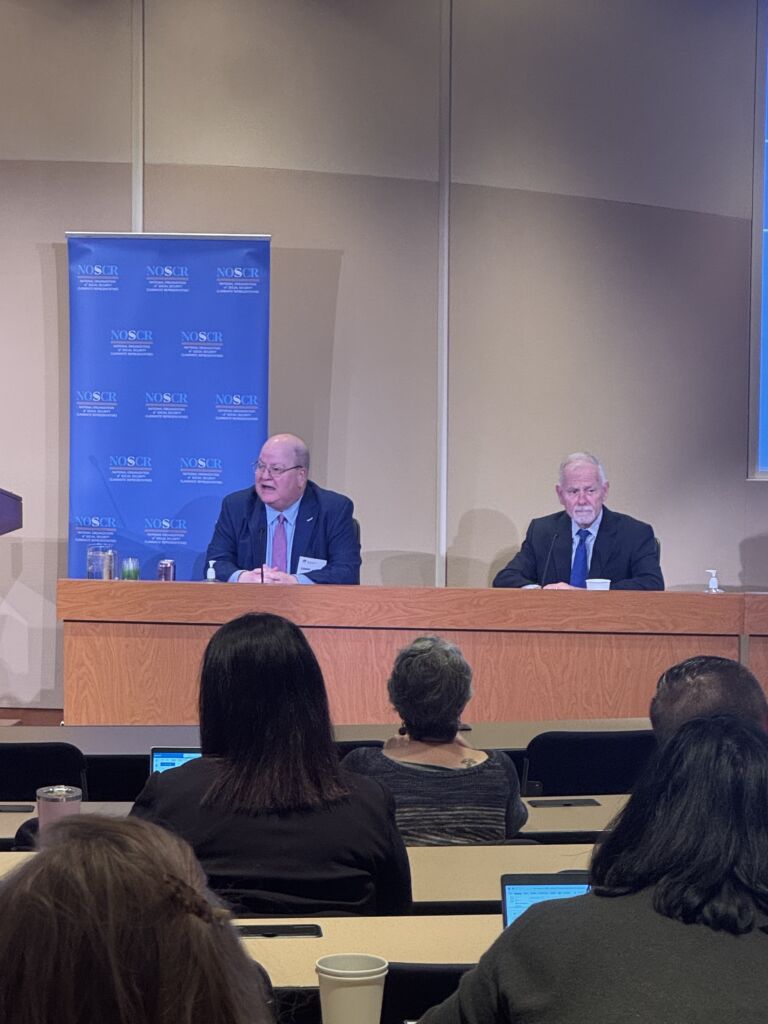
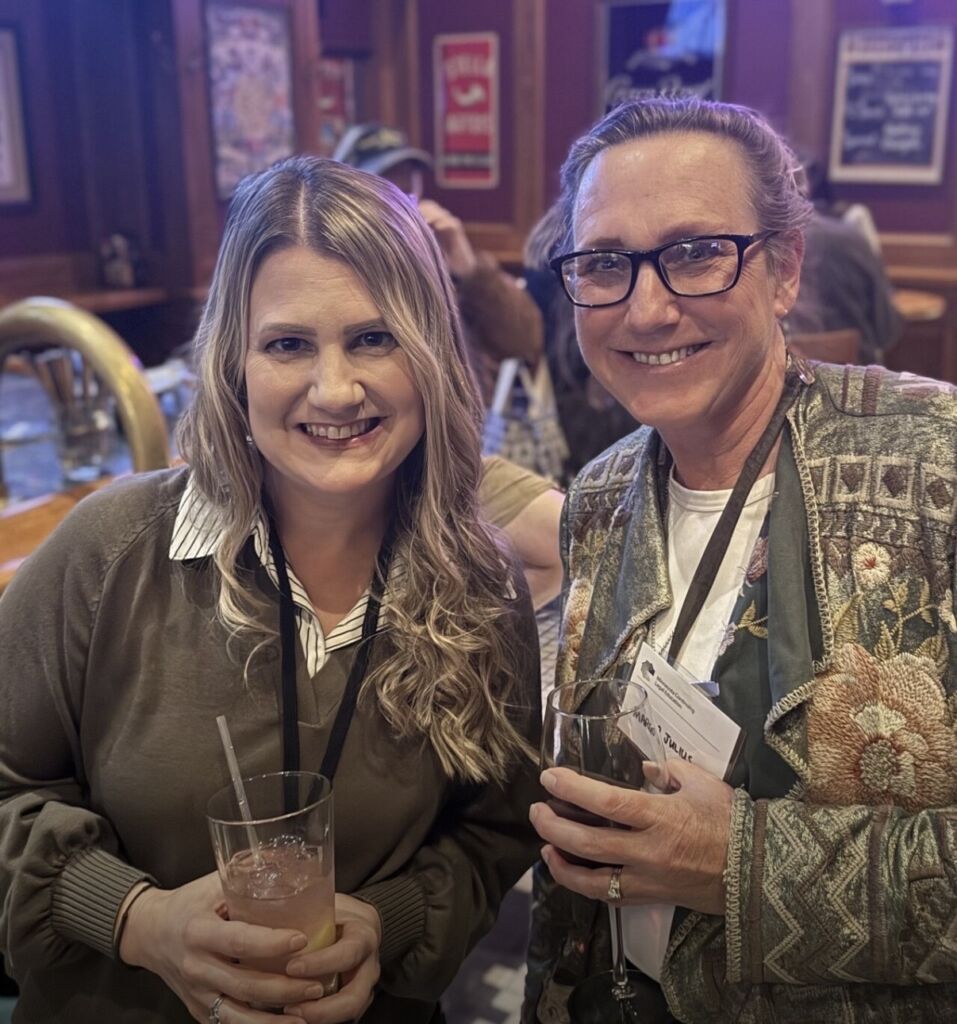
Another Fun and Informative 8th Circuit Mini-Conference
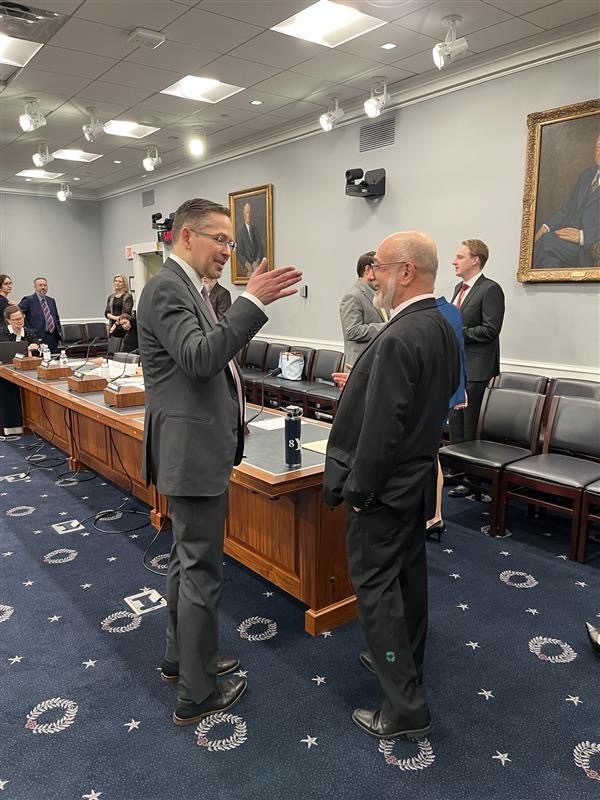
On November 6 & 7, we had our mini-conference/NOSSCR Roadshow in Minneapolis. It was great to see so many wonderful members in person and connect. We had great sessions with a Magistrate Judge, tips from Tom Krause and Ed Olson, A.I. ethics, and of course, some deep dives into VE issues, including Meghan Gallo’s impassioned presentation. We had updates from David about Agency/DC topics. We had other great presentations on proffer issues, business management, and case development.
It was an enlightening series of presentations, and I used a tip from Krause and Olson within a fortnight of the conference! The event was a big success, and I look forward to seeing more people in person in the future.


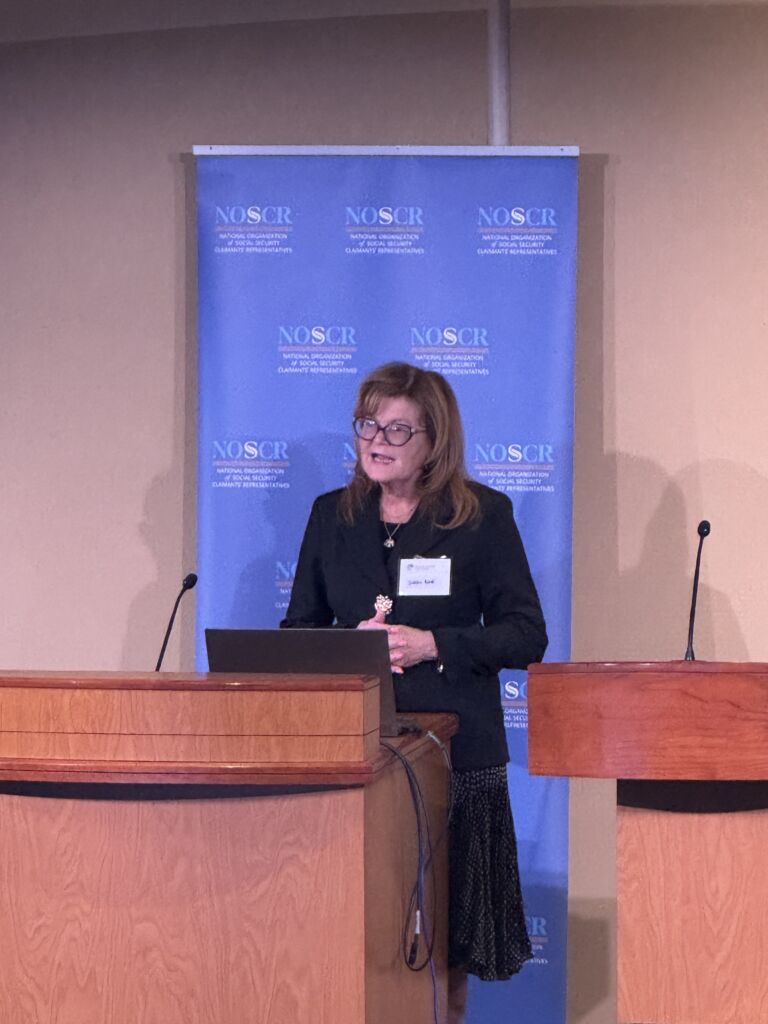
Join Our NextGen Casual Coffee Check-In December 2
Don’t miss your next chance for a quick check-in with fellow NOSSCR NextGen members—Tuesday December 2, at 12pm Eastern. These gatherings are informal and are a chance to network, ask questions, run hypotheticals, and just check-in with our community. These sessions are intended for new(ish) practitioners—those with fewer than 10 years in the field of Social Security disability, or those who are under 40 years old. The virtual gathering is free, but registration is required to get the link—so please register today, mark your calendars, and join us!
Celebrate Excellence in Our Community: Submit an Award Nomination
Eileen P. Sweeney Distinguished Service Award
NOSSCR presents the Eileen P. Sweeney Distinguished Service Award to one or more individuals whose outstanding service has resulted in a significant:
- Improvement in the quality of advocacy for Social Security claimants,
- Increase in the availability of advocacy for Social Security claimants, or
- Improvement in the Social Security adjudicatory process.
Eileen P. Sweeney was a nationally recognized expert on issues affecting people with disabilities who receive federal welfare benefits. From the time she was in college, through her work as a senior fellow at the Center on Budget and Policy Priorities in Washington, she sought to improve the lives of children, battered women, senior citizens, the poor and people with disabilities. From 1998 until her death in 2006, her focus had been the Temporary Assistance for Needy Families program and the Social Security and Supplemental Security Income programs. An advocate for the invisible in society, Ms. Sweeney assembled coalitions and coordinated litigation to help the people she thought needed it most. (Washington Post 7/2/2006). With this award, we honor her exemplary character and career.
Special consideration will be given to individuals whose service is provided on a pro bono basis. Award nominations must be made by a NOSSCR member, but the award recipient need not be a NOSSCR member. Nominations may be sent by providing the information requested here. Additional information may be requested. To see a list of past recipients, click here.
Nancy G. Shor Leadership Award
In May 2014, the NOSSCR Board created the “Nancy G. Shor Leadership Award.” This award, named in honor of NOSSCR’s founder and Executive Director from 1979 through 2013, will be awarded to an individual or organization that has shown exceptional leadership greatly benefiting NOSSCR or its constituents. A NOSSCR member, non-member, or an organization whose work and actions have gone above and beyond for NOSSCR or its constituents is eligible to receive this award. Award recipients will be chosen on the basis of their expertise, professionalism, and leadership, as well as their role in enhancing NOSSCR’s reputation as an outstanding, effective, and respected organization.
Nancy G. Shor, the first recipient of this award in 2015, founded NOSSCR in 1979 to advocate for Social Security Disability and Supplemental Security Income claimants and their legal representatives. She served as NOSSCR’s Executive Director from 1979 to 2013, and was Senior Policy Advisor for NOSSCR from 2013 until her retirement in 2016. It is through Nancy’s leadership that NOSSCR is recognized by the Social Security Administration, members of Congress and the public as an organization speaking on behalf of those living with disabilities.
With this award, we honor Nancy’s exemplary vision, leadership, and dedication to establishing NOSSCR as the pre-eminent organization advocating on behalf of Social Security representatives, claimants and beneficiaries.
The award will be presented when an appropriate recipient is identified. Award nominations must be made by a NOSSCR member, but the recipient need not be a NOSSCR member. Nominations may be sent by providing the information requested here. Additional information may be requested. To see a list of past recipients, click here.
Circuit Court Considerations: VE Conflicts and SSR 00-4p
Adriana de la Torre, NOSSCR Sustaining Member
VE Conflicts and SSR 00-4p: Ninth Circuit Weighs In
We have a notable remand out of the Ninth Circuit that’s especially relevant for anyone handling cases decided before January 6, 2025. The cutoff date for the transition from SSR 00-4p to SSR 24-3p.
This case is a clean example of what many of us have been arguing for years: Reasoning Level conflicts are real, and ALJs still have a duty to acknowledge and resolve them when raised.
Case Background
The claimant, Boyd, filed for disability benefits due in part to rheumatoid arthritis, a torn rotator cuff, and depression. The ALJ assessed an RFC limiting her to “simple, routine tasks.”
At hearing, the vocational expert (VE) identified three jobs—each classified at DOT Reasoning Level 2. As most of us know, Reasoning Level 2 requires the ability to:
“Apply commonsense understanding to carry out detailed but uninvolved written or oral instructions.”
However, on cross-examination, the VE explicitly acknowledged that an individual limited to simple, routine tasks could not perform work requiring the ability to follow detailed written or oral instructions.
That is an apparent conflict under SSR 00-4p.
The ALJ’s Error
Rather than resolving that conflict, as required, the ALJ dismissed it, relying on Emergency Message 21065, an internal SSA directive stating that reasoning levels should not be considered in assessing vocational conflicts.
The Ninth Circuit was not persuaded.
The court emphasized that because SSR 00-4p was still controlling at the time of Boyd’s decision, the ALJ remained obligated to identify and resolve any conflict between VE testimony and the DOT.
Failure to do so required remand.
Why This Case Matters
This decision reinforces what many of us have continued to argue, even while some adjudicators relied on EM 21065:
✅ Reasoning Level conflicts are “apparent conflicts”
✅ SSR 00-4p required ALJs to ask, and resolve, those conflicts
✅ VE testimony cannot override the DOT without a sufficient explanation
And importantly:
Cases decided prior to January 6, 2025, remain governed by SSR 00-4p, not SSR 24-3p.
So for any claims currently pending at Appeals Council or in federal court where the decision predates January 2025, keep raising these issues. This case strengthens the argument.
Practice Takeaway
When a VE identifies Level 2 (or Level 3) jobs for claimants limited to simple, routine, or one- to two-step tasks, always:
- Cross-examine the VE on the “detailed” instructions requirement.
- Make the SSR 00-4p objection clearly on the record.
- Argue the conflict in post-hearing briefs and at AC/federal review.
This is not hairsplitting. This is ensuring vocational evidence actually matches the RFC.
Precision in vocational evidence is not nitpicking, it’s competent advocacy.
Got any questions? Schedule a consultation with us. I’m here to help. It’s a lot to take in, but we’ll get through it together. After all, navigating these waters is always easier when you’ve got someone to chat with.
The views and opinions expressed in this article are the author’s own and do not necessarily reflect the views of NOSSCR, its leadership, or staff.
Practice Tip: Understanding and Resolving Scrambled Earnings
Ed Olson and Tom Krause
Social Security earnings records form the foundation of benefit calculations, yet even the most carefully maintained system can experience what the agency terms “scrambled earnings.” These situations arise when wages or self-employment income belonging to one individual are mistakenly posted to another person’s earnings record. For practitioners, recognizing and addressing scrambled earnings can mean the difference between accurate benefit amounts and protracted disputes with the agency.
The Program Operations Manual System defines scrambled earnings in straightforward terms at POMS RM 03870.045: they represent wages or self-employment income that have been credited to the wrong person’s earnings record. While the concept seems simple, the resolution process rarely is. The Social Security Administration acknowledges in that same section that untangling these errors often proves both difficult and time-consuming.
The complexity stems from several practical challenges. The transient nature of many workers—particularly in industries with high turnover or seasonal employment—can make it nearly impossible to locate individuals years after the earnings were reported. Even more problematic are cases involving identity theft or the unauthorized use of Social Security numbers, where one party may have deliberately used another’s identifying information for employment purposes. In these situations, establishing the true identity of the individuals involved becomes a prerequisite to any meaningful correction.
For attorneys representing claimants, scrambled earnings may surface during routine benefit calculations when expected earnings fail to appear on a client’s record, or conversely, when unfamiliar employers or income amounts appear. The discovery often comes at critical moments—during initial benefit applications, when calculating retirement or disability benefits, or during appeals when every quarter of coverage matters.
The implications extend beyond simple accounting errors. Scrambled earnings can affect whether a client meets insured status requirements for disability or retirement benefits under sections 214 and 223 of the Social Security Act. They can alter the calculation of Average Indexed Monthly Earnings under section 215, and ultimately change benefit amounts. When the scramble involves unreported or underreported earnings, it may also trigger questions about a client’s work history that require careful documentation and explanation.
Resolution requires persistence and thorough documentation. Practitioners should be prepared to gather employment records, tax documents, and any available evidence that demonstrates where the earnings actually belong. The agency will need to verify both that the earnings were incorrectly posted to one record and that they properly belong on another. The general provisions for correcting earnings records appear in POMS RM 03870.001 through the RM 03870 series, with the specific scrambled earnings guidance at RM 03870.045. In cases where the other individual cannot be located or where unauthorized number use is suspected, the process becomes even more involved and may implicate the provisions in POMS RM 10210.001 regarding misuse of Social Security numbers.
Understanding that scrambled earnings represent a recognized category of earnings record errors—one that the agency itself acknowledges as challenging—can help attorneys set realistic expectations with clients about resolution timelines. While the correction process may be lengthy, the POMS provisions at least provide a framework for addressing these situations when they arise. When confronting potential scrambled earnings issues, practitioners should document everything carefully, as the burden of proof for corrections under POMS RM 03870.010 ultimately rests with establishing the correct earnings record through credible evidence.
This is a guest column. The views expressed in this column are the views of the author alone, and do not represent the views of NOSSCR, NOSSCR’s leadership, or NOSSCR’s staff.
Senate Finance Committee Advances the Nomination of Arjun Mody to be Deputy Commissioner of Social Security
On November 19, 2025, by a vote of 14-13, the Senate Finance Committee advanced the nomination of Arjun Mody to be Deputy Commissioner of Social Security. Chairman Mike Crapo (R-ID) issued the following statement: “As a veteran of Capitol Hill, Mr. Mody is well equipped to assist Commissioner Bisignano in administering the programs overseen by the Social Security Administration.”
From here, the nomination is expected to be called for a full Senate vote, where a simple majority will be needed to confirm the nomination.
Legislative Spotlight
Betsy Rosecan, NOSSCR Government Relations Director
On July 23, 2025, Representative Melanie Stansbury (D-NM) introduced the Hands Off Our Social Security Act (H.R. 4734). The bill has 37 cosponsors, all Democrats, and has been referred to the House Committee on Ways and Means, where it awaits further action. There is currently no companion bill in the Senate.
If enacted, this legislation would prohibit any alteration, withholding, or delay of Social Security benefits unless expressly authorized by Congress, and would bar the unauthorized collection or use of beneficiary data beyond what is allowed under federal privacy laws. The bill would also prevent the privatization of Social Security services, restrict workforce reductions at the Social Security Administration without congressional approval, and prohibit the closure or consolidation of SSA offices absent explicit authorization from Congress. Additionally, it would require SSA to maintain its essential telephone and in-person communication services and direct the Government Accountability Office to conduct annual audits of SSA workforce levels, office operations, and communication systems to ensure compliance with the Act.
Bill Details
SECTION 1. Short title.
This Act may be cited as the “Hands Off Our Social Security Act”.
SEC. 2. Purpose.
The purpose of this Act is to ensure the continued effective operation of the Social Security Administration and to protect Social Security services for all Americans by prohibiting tampering with benefits, unauthorized data mining, privatization efforts, workforce reductions, office closures, and communication changes that hinder access to Social Security benefits.
SEC. 3. Prohibition on tampering with social security benefits.
(a) No Federal officer, special government employee, or contractor shall alter, withhold, or delay Social Security benefits in any manner that is not authorized by law.
(b) Any action to modify Social Security benefits shall require an Act of Congress.
SEC. 4. Prohibition on unauthorized data mining and privacy violations.
(a) No Federal officer, special government employee, or contractor shall collect, share, or use Social Security data or personally identifiable information of beneficiaries or applicants for any purpose other than administering Social Security programs consistent with existing privacy laws.
(b) Any data mining or use of Social Security or personal data for commercial, political, or unauthorized purposes is prohibited.
(c) Violations of this section shall be subject to investigation and penalties under applicable Federal privacy and data protection laws.
SEC. 5. Prohibition on privatization of Social Security benefits and services.
(a) No action shall be taken to privatize, outsource, or otherwise transfer Social Security benefits administration or services to private entities without express approval by an Act of Congress.
(b) The Social Security Administration shall remain a Federal agency responsible for the administration and delivery of Social Security benefits.
SEC. 6. Prohibition on unauthorized workforce reductions at the SSA.
(a) No officer or special government employee of the Federal Government shall implement or authorize any reduction in the workforce of the Social Security Administration without approval from an Act of Congress.
(b) Any reduction in SSA staffing levels shall require a detailed report to Congress, including the anticipated impact on service delivery and plans to maintain adequate service levels.
SEC. 7. Prohibition on closure of SSA offices without Congressional consent.
(a) The closure or consolidation of any Social Security Administration office or field office shall be prohibited unless expressly authorized by an Act of Congress.
(b) The SSA shall maintain a minimum number of fully operational field offices in each state proportional to the population served.
SEC. 8. Maintenance of multi-channel communication systems.
(a) The Social Security Administration shall maintain its existing telephone and in-person communication services and ensure its effectiveness as essential channels for beneficiary assistance.
(b) Any changes to communication methods, including use of social media platforms such as Twitter, shall be supplementary and not replace existing official communication channels.
(c) No communication services essential to SSA beneficiaries shall be terminated or diminished without prior approval by an Act of Congress.
SEC. 9. Enforcement and oversight.
(a) The Government Accountability Office (GAO) shall conduct annual audits of SSA workforce levels, office operations, and communication services to ensure compliance with this Act.
(b) The Comptroller General shall report findings to Congress, including any noncompliance and recommendations for corrective action.
SEC. 10. Severability.
If any provision of this Act, or the application thereof, to any person or circumstances, is held invalid, the remainder of the Act, and the application of such provisions to other persons or circumstances, shall not be affected thereby.
NOSSCR Attends Make America Healthy Again Summit
MAHA Summit Features Discussion with Vice President J.D. Vance and HHS Secretary Robert F. Kennedy Jr.
Vice President J.D. Vance and Robert F. Kennedy Jr., Secretary of Health and Human Services, participated in a discussion at the Make America Healthy Again (MAHA) Summit held at the Waldorf Astoria in Washington, D.C. The conversation focused on “unconventional thinking” and new approaches to public policy, with both leaders emphasizing the importance of independent perspectives, open dialogue, and a willingness to challenge long-standing assumptions. Vice President Vance highlighted these traits as essential to navigating the nation’s current political and economic environment, while Secretary Kennedy underscored the role of innovation in federal health policy.
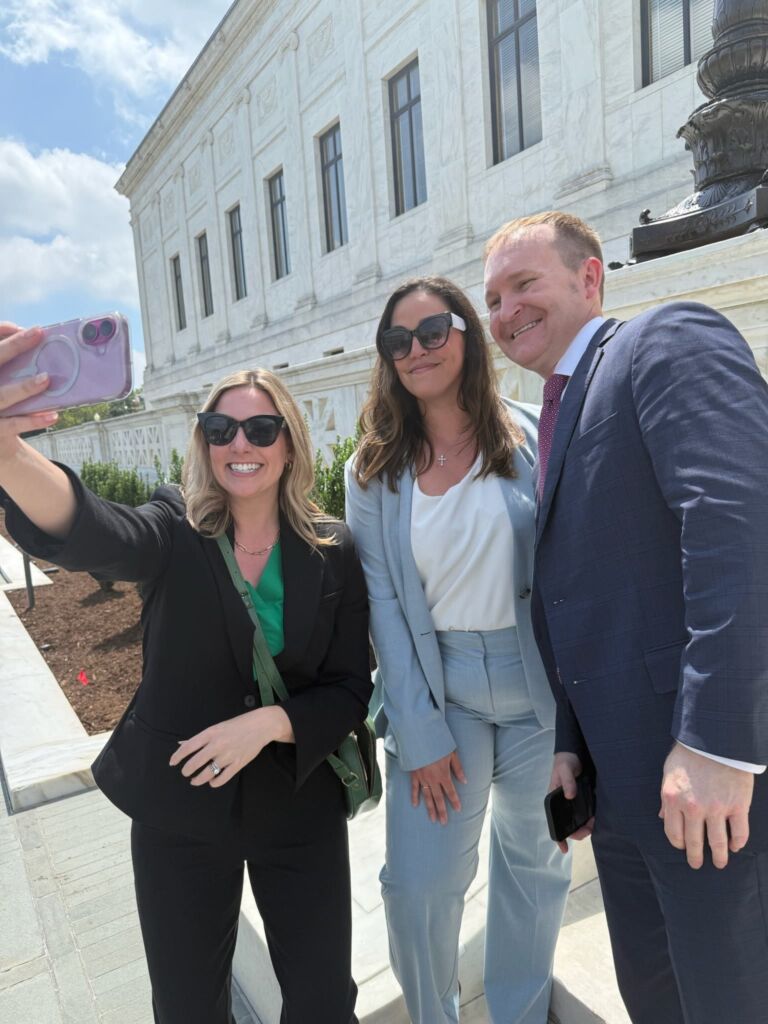
For NOSSCR, the event provided a timely opportunity to observe how senior administration officials are framing broader policy conversations that may influence federal priorities in the months ahead. Senior Policy Advisor David Camp and Government Affairs Director Betsy Rosecan attended on behalf of NOSSCR, engaging with attendees and monitoring discussions that could shape cross-agency coordination on issues affecting claimants. Although Social Security was not a central topic, themes related to administrative modernization, interagency cooperation, and the role of federal leadership in improving public-facing services have clear implications for the disability adjudication process and NOSSCR’s ongoing advocacy.
PAC Contributor List
THANK YOU TO OUR NOSSCR PAC CONTRIBUTORS
As of November 2025
| First Circuit David Ferrari (C) Second Circuit Crysti Farra (CC) Sarah Frederick (CC) Maurice Maitland (C) Lino Medina Mendez (C) Third Circuit Maryjean Ellis (CC) Melissa Green (C) Alicia Hutchinson (CC) Timothy Mello (CC) Judson Perry (CC) Alan Polonsky (PC) Joseph Silver (C) Christine Trotz-Cosgrove (CC) Fourth Circuit Jonathan Blair Biser (C) Ben Clauson (CC) Vaughn Clauson (DC) Rick Fleming (DC) George Piemonte (CC) Michelle Pritchard (CC) Ashley Hartman Sappenfield (CC) Joanna Suyes (CC) Robertson Wendt (CC) Fifth Circuit Paul Burkhalter (CC) Matthew Edwards (C) Jacob Hugentobler (CC) Patrick O’Neal (CC) David Pogue (CC) David Lance White (CC) |
| Sixth Circuit Edward Ahlers (CC) Gary Bimberg (PC) Donald Busta (PC) Lorenzo D’Agostini (CAP) Bobby Ficklin, Jr. (C) Joseph Houle (PC) Michael Alexander Rake (CC) Debra Shifrin (CAP) Donna Simpson (CC) Seventh Circuit Eric Farr (CC) Richard Feingold (CC) Brian Harmon (PC) Joseph Houle (PC) Avram Sacks (CC) Lindsay Solon (CC) Thomas Thompson (CC) |
Key:
CAP=Capitol Club, $5,000/monthly contribution of $416
PC=Platinum Club, $2,500-$4,999/ monthly contribution of $208-415
DC=Diamond Club, $1,000-$2,499/monthly contribution of $83-207
CC=Century Club, $100-$999
C=Contributor, all other contributions
| Eighth Circuit Jeffrey Bunten (PC) Julie Burkett (DC) David Camp (CAP) Patrick Cavanaugh (CC) Sean Cuddigan (PC) Meghan Gallo (CC) Matthew Grundy (DC) Thomas Krause (PC) Theodore Norwood (PC) Kyle Sciolaro (CC) J. Asha Sharma (CC) Tim Tripp (CC) Felicia Von Holten (C) Ninth Circuit Mark Bunch (DC) Sara Carroll (CC) Paul Clark (CC) Richard Gutstadt (DC) Marc Kalagian (DC) Kevin Kerr (CC) Audrey Miller (C) Eric Penar (PC) Jose Vera (C) Timothy Walker-Dupler (CC) Tenth Circuit Ann Atkinson (DC) Dan Bott (CC) John Harlan (PC) Gary Jones (CC) Philip Ryan (PC) Gayle Troutman (DC) Steve Troutman (DC) William Viner (CC) Eleventh Circuit Jason Bailey (CC) Sarah Bohr (CC) Kevin Hall (CC) David Wright (CAP) |
Contributions to the National Organization of Social Security Claimants’ Representatives PAC (NOSSCR PAC) are not tax-deductible as a charitable contribution for federal income tax purposes. Contributions to NOSSCR PAC will be used to support federal and state candidates, political parties, and other political committees. Contributions are strictly voluntary. You may refuse to contribute without reprisal. Any proposed contribution level is merely a suggestion, and you are free to contribute more or less than suggested. You will not benefit or be disadvantaged by reason of the amount of your contribution or a decision not to contribute. Federal law requires NOSSCR PAC to use its best efforts to collect and report the name, mailing address, occupation and employer of persons whose contributions exceed $200 in a calendar year. You must be a U.S. citizen or lawfully admitted for permanent residence in the U.S. to contribute.
Social Security Advisory Board Announces the Appointment of Amy Shuart as Chair
The Social Security Independence and Program Improvements Act of 1994 established a bipartisan Social Security Advisory Board composed of up to seven Board members appointed by Congress and the White House. The Board’s mission is to “advise the President, Congress, and Commissioner of Social Security on the Social Security and Supplemental Security Income programs. The Board is comprised of Presidential and Congressional appointees supported by professional staff.”
This month, the President designated Amy Shuart as Chair of the Social Security Advisory Board. Shuart has served as a Board Member on the SSAB as the House Republican appointee since October 2022. She previously served on the Ways and Means Social Security Subcommittee staff from 2011 to 2021, serving as Subcommittee Staff Director from 2015 to 2021.
Daily Dose of Data from SSA
This month, data from Social Security remained limited due to the government shutdown; however, the agency did release the following:
- Social Security Bulletin, Vol. 85, No. 4
- Which includes the following article: Economic Security in Retirement for Parents of Children with Disabilities: Findings from a Mixed-Methods Study by Molly Costanzo, Lisa Klein Vogel, Liesl Hostetter
- From the abstract: “This article examines the economic well-being of families in which a retired parent cares for a child with a disability. Using data from the Survey of Income and Program Participation and in-depth interviews, the authors analyze household economic circumstances, Social Security benefit adequacy, and caregivers’ concerns about their children’s futures. The authors find that these households experience disproportionate economic hardship despite receiving Social Security benefits, and caregivers express substantial worry about their children’s long-term financial security and care arrangements.”
Useful Resources
OHO Caseload Analysis Report — still not updated for this month or last post-shutdown
State Medical Records Payment Rates
Social Security Rulings and Acquiescence Rulings by Year
HALLEX Contents & Recent Changes